
 0086-20-3156-0779


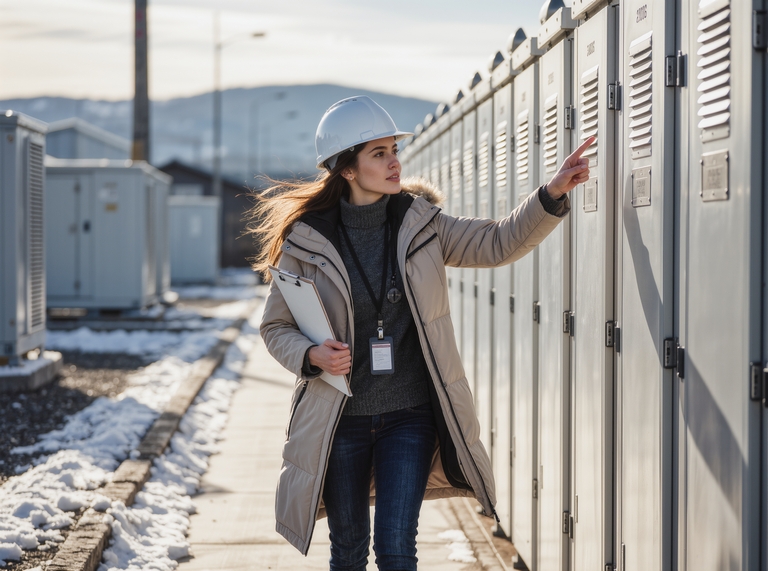
On October 30, the National Energy Administration used its quarterly press conference to put a number on something operators have felt all year. China's operational new-type storage fleet reached 167 GW / 435 GWh at the end of September, up 63% year on year. Against 135.93 GW / 351.12 GWh reported at the end of 2025, that works out to roughly 31 GW and 84 GWh added in nine months, in a power system where wind and solar already account for 48.7% of installed capacity.
The capacity number is the one that gets quoted. The two figures printed beside it matter more for anyone hiring. Average storage duration rose to 2.61 hours, about 0.27 hours longer than a year earlier, and equivalent utilization hours reached roughly 915 for the nine-month period, up about 10 hours. Longer duration and busier dispatch mean the fleet is shifting from a construction story to an operating one. That shift changes what a site director is paid to do, and it is already splitting the job in two.

The revenue rulebook moved first
Jobs follow cash flow. In January, the National Development and Reform Commission and the NEA issued Document 发改价格〔2026〕114号, which for the first time set out a capacity price mechanism for grid-side independent new-type storage. By early 2026, nine provincial-level governments had published their own capacity compensation policies, among them Hubei, Gansu, Ningxia, Zhejiang, Hebei, Guangdong, Inner Mongolia, Xinjiang and Anhui.
The details of those policies decide who gets hired. Shandong pays capacity compensation at RMB 0.0705 per kWh, and its April 2026 revised rules tie the payment to daily available equivalent hours in a way that gives a four-hour system twice the compensation of a two-hour system. Anhui's provincial energy bureau said that through 2026 grid-side independent storage there has earned most of its money in the spot market, with charge and discharge settlement around RMB 0.23 per kWh, and that annual cycling counts vary station by station.
Read those two sentences together and the hiring problem appears. A site that earns from availability is managed like an asset with a compliance calendar. A site that earns from spreads is managed like a trading desk with a battery attached. They are not the same person, and in most Chinese operators they are still one job title.

Two jobs wearing one name
The first job is commissioning. Someone has to take a 200 MWh site from energization through grid-connection tests, protection settings, fire-safety acceptance and commercial operation date, while the EPC contractor, the provincial dispatch centre and the lender's independent engineer all push in different directions. The currency here is days and signatures. A week of delay on a 100 MW project is not an abstraction, it is interest and liquidated damages.
The second job is operation. Once the site is in the market, the currency becomes spread capture, availability percentage, state-of-health curves and degradation budgets. The person doing it has to decide each morning whether to charge at noon and discharge at the evening peak, whether to hold capacity back for frequency regulation, and how much of the battery's cycle life to spend on a thin arbitrage window. That work is closer to a utility trading floor than to a construction site.
China's project mix makes the split sharper. Official 2025 figures show independent storage made up 51.2% of cumulative new-type installations, projects rated 100 MW and above accounted for 72% of installed capacity, and systems of four hours or longer reached 27%. Big, long-duration, merchant-exposed assets need both a builder and an operator, often at the same time.
A case worth studying is Mingyang's Baotou Weijun project in Inner Mongolia. Its 500 kV collection station completed testing and entered operation in July 2026, and the 400 MW / 2.4 GWh six-hour lithium project reached full-capacity grid connection on July 31 that year. A 500 kV interconnection is a different animal from a 35 kV feeder. The number of engineers in China who have closed one successfully, on schedule, with a provincial grid company watching, is small enough that you could put most of them in one room.

What the money says
Compensation data tells the same story from two ends. ZW HR Consulting's 2026 new-energy power salary report puts the upper limit for a storage chief engineer at RMB 1.5 million and projects 15% to 25% annual pay growth for storage roles through 2027, with power electronics specialists acting as the anchor for the whole sector.
Then look at the volume end. On jobs site 职友集, 49.1% of storage engineer postings pay RMB 8,000 to 15,000 a month, based on 285 samples current to November 7, 2026, with only 8.8% above RMB 30,000. The distance between a mid-level engineer and a chief engineer is not a ladder, it is a different market with different buyers.
That gap is why so many searches fail in the same place. A client writes one job description that asks for grid-connection experience, spot-market bidding experience, O&M management and investor reporting, then wonders why the shortlist is thin. The candidates who can close a 500 kV station usually cannot build a bidding model, and the ones who can trade a battery often have never stood on a commissioning site at two in the morning.

The hiring sequence is usually wrong
One timing mistake repeats across almost every operator we speak with. The commissioning director is hired in the first month of construction, which is correct. The trading or asset-management lead is hired at commercial operation, which is six months late. Bidding strategy, market registration, telemetry calibration and the first season of price data all have to be in place before the site earns a single yuan in the spot market. A trader who arrives on COD day inherits a battery with no price history and a team with no market habits.
Non-compete clauses make the delay expensive. Engineers who have signed off on high-voltage interconnection or worked directly with provincial dispatch often carry 竞业限制 obligations covering the same province for six to twelve months. In a province with two or three active owners, that restriction empties the candidate pool at exactly the level clients want. Realistic hiring cycles for directors with genuine grid-connection records run four to six months, and the clock starts before the project does, not after.
None of this means commissioning skills have stopped mattering. If anything, the 27% of capacity now built at four hours or longer raises the technical bar, because long-duration systems put more stress on thermal management and state-of-charge balancing. The point is narrower: one person can no longer be measured on both the calendar and the P&L without one of them slipping.

What operators in Hefei, Jinan and Baotou are actually doing
In our own searches this autumn across Anhui, Shandong and Inner Mongolia, the pattern is consistent. Candidate CVs cluster heavily on the build side, with project lists that read like a construction résumé: capacity, voltage level, COD date. Very few show twelve consecutive months of market-based revenue performance, because very few people in China have had the chance to produce it. Merchant storage at this scale is young.
The clients getting it right tend to do four things. They write two scorecards instead of one, and stop interviewing commissioning engineers for trading seats. They start the asset-management search half a year before COD. They map by province rather than by company, because the grid-connection knowledge they need is provincial. And they structure pay as fixed plus a meaningful variable component, since scarce candidates in this market negotiate on upside, not base.
The internal route is also underused. A commissioning lead who has spent two years with one asset is the cheapest candidate for the site director role, but only if the company gives that person market exposure before handover instead of after.

The next twelve months
CNESA expects China's cumulative new-type storage capacity to end 2026 somewhere between 200.7 GW and 221.9 GW, a forecast on a different statistical basis from the NEA's operational figure, so the two should be read side by side rather than added together. Whichever number you prefer, the direction is the same: more megawatt-hours, longer duration, more market exposure.
For hiring teams, that means the site director question will keep arriving, and it will keep arriving as two questions. The operators who answer them separately, and answer them early, will be the ones whose assets earn in year one instead of year three. Henderson Executive (China Headhunting Service) works these searches province by province, and the difference between a good and a bad hire at this level is usually visible in the first quarter of market operation, not in the interview.
For companies building and staffing storage assets in China, the practical question is not whether to hire a site director. It is which of the two jobs you are filling, and whether the search can finish before the meter starts running. Henderson Executive has run both profiles across Anhui, Shandong and Inner Mongolia, and the two rarely share a shortlist.






 Instant Retail Passes RMB 1 Trillion. Singles' Day Hiring Moved From Ad Spend to Store Ops
