
 0086-20-3156-0779


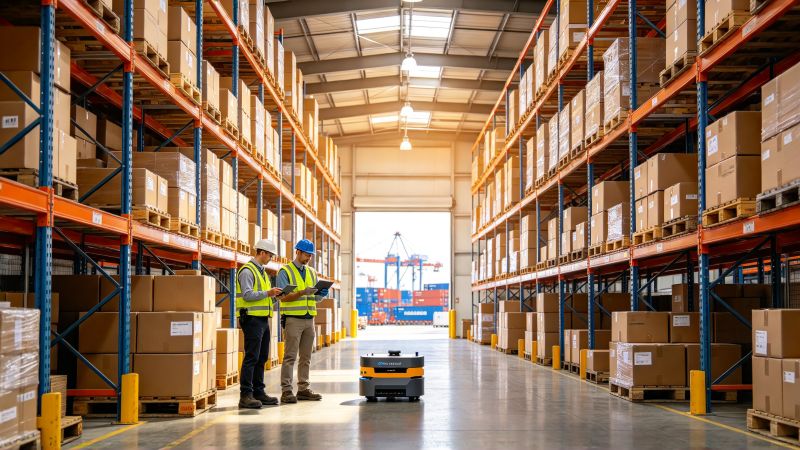
On 22 July 2026, the State Council Information Office held a briefing on modernising China's customs system. Customs Minister Sun Meijun offered three numbers to illustrate trade momentum: 115,000 more enterprises conducted import and export business in the first half, cross-border e-commerce exports through overseas warehouses grew 3.3 times, and 140 million Chinese consumers now buy globally through cross-border e-commerce. The same briefing carried a set of high-growth figures for high-tech exports (up 39 percent), electric vehicles (up 68.7 percent) and integrated circuits (up 88.7 percent). All were double-digit percentages. Only the warehouse channel was described as a multiple.
The distinction matters. A percentage describes a category selling more. A multiple describes the delivery route moving: a consignment that once left Shenzhen or Yiwu parcel by parcel now travels in full containers to warehouses in Los Angeles, Frankfurt or Warsaw, and ships locally once an order arrives. Customs measures trade modes; companies experience a relocation of inventory and the people who run it.
The first correction is that 3.3x refers to the value of trade conducted through the overseas warehouse model. It does not mean the number of warehouses tripled. The two figures are frequently conflated, and they mean different things. Customs data shows China’s cross-border e-commerce imports and exports reached RMB 2.84 trillion in 2025, up 4.8 percent, and RMB 1.37 trillion in the first half of 2026, up 10.3 percent. Against a base growing around ten percent, a triple-digit multiple in one channel signals rapid substitution rather than broad acceleration.
Local customs data shows how dense that substitution has become. Shenzhen recorded RMB 87.63 billion in overseas warehouse exports in the first five months, up 12.3 times year on year. Hangzhou Customs supervised RMB 66.69 billion in cross-border e-commerce trade from January to August, up 7.3 percent, of which RMB 24.58 billion moved through overseas warehouses, up 2.6 times. More telling is the count of entities: Hangzhou companies exporting through overseas warehouses rose from 154 to 1,283 in a year. Henderson Executive Search has tracked this reallocation of inventory through search mandates in Shenzhen, Hangzhou and Ningbo, and the staffing implication does not sit with warehouse hands alone.
| Metric | Figure | Basis and source |
| Overseas warehouse export growth | 3.3x in H1 2026 | General Administration of Customs, State Council briefing, 22 July 2026 |
| Cross-border e-commerce trade | RMB 2.84trn in 2025, +4.8%; RMB 1.37trn in H1 2026, +10.3% | General Administration of Customs, 2026 |
| Shenzhen warehouse exports | RMB 87.63bn in first five months, +12.3x | Shenzhen customs basis, 2026 |
| Zhejiang warehouse exports | RMB 24.58bn Jan-Aug, +2.6x; Hangzhou entities up from 154 to 1,283 | Hangzhou Customs, September 2026 |
| Warehouse count and area | Over 2,500 warehouses and 30m sqm built by Chinese firms; warehouses serving Chinese flows rose from 5,300 to 6,200 since early 2025 | Ministry of Commerce; Kuajingyan 2026 Overseas Warehouse Blue Book |
| Model mix forecast | Warehouse model expected to overtake direct mail in 2026, reaching 50.6% of market value | CSC Financial research note, 2026 |
To understand the shift, the regulatory calendar matters more than any single company’s strategy. From 1 July 2026, the European Union began levying a flat EUR 3 duty on imported parcels below EUR 150. The United States had already removed duty-free treatment for shipments under USD 800, and Vietnam intends to cut its threshold from USD 38 to USD 3.8. Three major markets tightened in the same window, leaving the duty-free parcel model carrying a structural cost.
Once the cost structure changes, so does the delivery model. Per-parcel duty, clearance time and returns handling become unpredictable under direct mail, while the warehouse model folds those costs into bulk first-leg freight and local delivery. CSC Financial expects the warehouse model to overtake direct mail in 2026 for the first time, reaching 50.6 percent of market value. If that holds, the centre of gravity moves another step from traffic acquisition toward inventory.
The customer base is changing with it. Li Hua, general manager of Ouzhimeng Overseas Warehouse, observes that merchants in 2024 and 2025 were mostly asset-light sellers on fully managed platforms, while the 2026 cohort has shifted toward mid-sized and large brands able to hold inventory. Product mix moved from consumer electronics and toys toward small appliances, functional beauty and outdoor tools. An asset-light seller can run stores remotely with one operations team, while an asset-heavy seller needs someone accountable for how much stock to hold, which warehouse holds it and when to replenish.
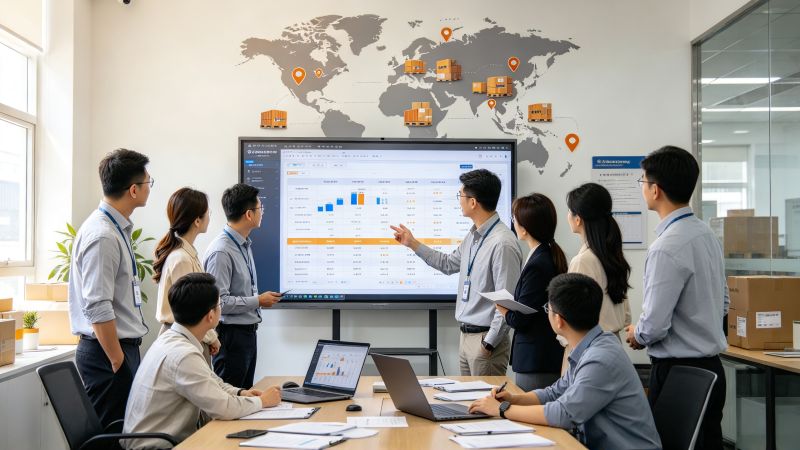
Warehouse network scale is the most legible measure of fulfilment capability. The Kuajingyan 2026 Overseas Warehouse Blue Book counts warehouses primarily serving Chinese cross-border flows at more than 6,200, up from 5,300 at the start of 2025, an 18.38 percent increase; the same series shows roughly 1,260 in 2021 and 4,436 in 2024. The Ministry of Commerce publishes a separate figure of more than 2,500 warehouses and over 30 million square metres, counting facilities built by Chinese companies. The two definitions describe different sets.
The pace at the top is more instructive. Zongteng Group's Gucang Overseas Warehouse announced in March 2026 that global area had passed 3.6 million square metres: 2.25 million in North America, 1.2 million in Europe and 150,000 across Asia-Pacific and domestic transshipment. It runs more than 120 processing centres, handles over 1.2 million orders a day, covers 30-plus countries and employs over 10,000 people. North American area grew 73 percent year on year and European area 71 percent, extending from the UK-France-Germany triangle into 15 European countries. Gucang’s first million square metres took six years; expansion has accelerated since, because scale-driven cost dilution in warehousing is close to irreversible.
Peers fill in the asset density. Cainiao runs more than 50 overseas warehouses across 18 core markets and launched a three-day global delivery product in August 2026. JD Logistics covers 26 countries with over two million square metres under management, 4PX operates more than 50 warehouses above one million square metres, and WINIT runs 15 sites of nearly 500,000 square metres for over 20,000 sellers.
Capacity running ahead of orders is the recurring risk. The Blue Book's 2025 data on throughput per warehouse shows the divergence: Mexico up 257.05 percent, the United States up 119.17 percent, France up 116.34 percent and Poland up 90.21 percent, while Russia fell 39.25 percent. Russia’s warehouse count doubled in the same period, yet outbound orders among established operators grew only 21.51 percent. Warehouses are easy to build and hard to fill, and filling them depends on the forecasting and allocation capability of an operations team. Henderson Executive Search mandates in cross-border logistics surface the same constraint: space can be leased, the operator who fills it cannot.
A job description updated in September for an overseas warehouse operations manager shows where the boundary now sits. The first duty covers end-to-end fulfilment for drop-shipping: inbound appointments, receiving and put-away, wave picking, packing and outbound, and returns. The KPIs are hard numbers: inventory accuracy no lower than 99.95 percent, on-time dispatch, mis-shipment below three per thousand, and 24-hour closure of exceptions.
The second duty is inventory granularity, requiring a four-layer model of sellable, in-transit, reserved and clearance stock, monitoring SKU age and sell-through, and leading WMS upgrades. The third is cost: a per-order and per-SKU model that penetrates first-leg freight, storage, last-mile and returns loss to reconstruct true margin on a single order. The fourth is returns, covering inspection, relabelling, refurbishment and relisting. Only the fifth concerns people, coordinating an overseas team remotely and building customised procedures for key accounts.
Taken together, those duties exceed conventional warehouse management. They require three capabilities at once: hands-on knowledge of the full cross-border logistics chain and where each leg fails; data analysis and cost modelling strong enough to break an invoice down to SKU level; and the ability to coordinate teams across time zones, because the warehouse is on site while decisions are made in China. People with all three are a small population.
An overseas warehouse manager role at a Shanghai furniture and home goods company writes compliance into the duties: GPSR and EPR compliance for European warehouses, handling of battery-powered products, monitoring platform warehouse performance and setting penalties for underperformance. The same role leads site sourcing, quote comparison, negotiation and supplier elimination. In substance this is the interface between warehouse assets and external providers, accountable internally for inventory and externally for 3PL pricing, transit times and claims. Inventory planning and supply chain planning weigh more heavily here than hands-on warehouse experience. Consultants at Henderson Executive Search describe this as a recurring brief in fulfilment hiring.
Public postings over the past month show pay settling into three layers. An overseas warehouse operations manager based in the United States, requiring five years of experience including three in drop-shipping, is advertised at RMB 35,000 to 50,000 a month. A warehouse manager for a Shanghai furniture and large-item seller sits at RMB 30,000 to 35,000. A warehouse and customs project manager posted to Peru offers RMB 18,000 to 35,000 plus allowance, flights and home leave. A Chongqing food chain lists RMB 270,000 to 400,000 annually. Third-party samples for one logistics firm show 13 postings all within RMB 30,000 to 50,000, with the average rising from RMB 37,500 in 2025 to RMB 40,000 in 2026. Henderson Executive Search compensation benchmarks across the sector point the same way.
| Role | Pay signal | Core requirements | Source |
| Overseas warehouse operations manager (US-based) | RMB 35,000-50,000/month, 5+ years | Drop-shipping chain, four-layer inventory model, WMS iteration, SKU-level costing | Public posting, 22 September 2026 |
| Overseas warehouse manager (Shanghai, large items) | RMB 30,000-35,000/month, 3-5 years | Network planning, 3PL sourcing and negotiation, GPSR/EPR compliance, vendor scorecards | Public posting, 15 October 2026 |
| Warehouse and customs project manager (posted to Peru) | RMB 18,000-35,000/month plus allowance | Destination clearance coordination, broker management, warehouse SOPs, exception handling | Public posting, September 2026 |
| Overseas warehouse operations (Chongqing, food chain) | RMB 270,000-400,000/year, 3-5 years | End-to-end coordination, EU/US warehouse resources, VAT and duty compliance, clearance rate above 99% | Search-firm listing, 20 September 2026 |
| Livestream host (reference point) | RMB 5,000-10,000/month; top bilingual hosts RMB 15,000-30,000 | Language delivery, category knowledge, conversion | Industry talent report, 2026 |
The three gaps differ in nature. The first is the warehouse operations leader, accountable for the P&L of a pool of inventory, where qualified candidates are few and most companies promote from a cross-border logistics firm or a large seller. The second is customs compliance, a demanding professional threshold that regulation keeps pushing higher. The third is regional operations and localisation, requiring fluency in both Chinese e-commerce playbooks and local content ecosystems, creator networks and minority-language service. Henderson Executive Search works all three pools, and they rarely overlap.
Industry talent reports split the market into three tiers: store operations at the execution level, operations managers at the backbone level and operations leaders at the decision level. The execution-level pool has thickened as universities added programmes and training providers multiplied, while scarcity sits in the middle and at the top. That matches the pay bands: execution roles are compressed around RMB 10,000 a month, while roles accountable for full-chain profitability start at RMB 30,000. Cross-border e-commerce operations manager has entered China’s national occupational classification, and AI operations and compliance roles are identified as the clearest growth area for 2026.
In this transition, the first shortage tends to appear in customs rather than in the warehouse. The metrics in job descriptions show why: a clearance rate no lower than 99 percent, handling of inspections and holds, early-warning systems for peak congestion and policy shifts, and control of EU VAT and US duty exposure. Behind those requirements sits a set of technical details changing simultaneously, including HS classification, rules of origin, duty deferral and rebates, EU GPSR and EPR producer responsibility, and the transport and admission rules for battery-powered goods.
The EU's flat EUR 3 duty on parcels below EUR 150 from July pushed the long-standing all-inclusive clearance arrangement into the open. Freight forwarders used to quote a single price and sellers did not need to care about tariff classification. Now duty is itemised, and declared value, category and certificates of origin each affect final cost and inspection probability. A single misclassification can hold an entire consignment at the border while storage and demurrage accrue by the day. That risk cannot be solved by working longer hours; it requires someone who designs the route before the contract is signed.
The role is therefore moving upstream. Its input is product and supply chain, since packaging, materials and function determine classification. Its output is finance and legal, since duty rates, deferral and transfer pricing affect the income statement. Scarce customs professionals can structure compliance before contracts are signed. They come from a narrow set of places: senior roles at international forwarders and brokerages, compliance teams at cross-border platforms, customs advisory lines at professional services firms, and the heads of customs at a handful of large sellers.
Compliance pressure on the warehouse side is rising in parallel. European sites handle GPSR and EPR, US sites handle FDA and CPSC requirements by category, and battery-powered products add storage and transport qualifications. Warehouse, customs and tax are merging into a single brief, and a role titled warehouse and customs project operations manager posted to South America shows the industry folding the two together. Henderson Executive Search has seen customs briefs move from support functions to the shortlist.
Mid-to-senior hiring in cross-border e-commerce runs into a familiar problem: many CVs look plausible and few candidates survive scrutiny. Criteria such as cross-border experience, a specified GMV figure and a big-platform pedigree shrink the pool to single digits, and most of those people are not looking.
Industry talent reports describe three sourcing channels. The first is proven operators at brand-export companies, where a cohort built full-chain experience moving from broad catalogue selling into brand building, the strongest profiles and the least responsive to outreach. The second is operators raised inside platform ecosystems, who know how algorithms and rules evolved. The third is capability transfer from adjacent industries, where heads of domestic e-commerce operations or e-commerce directors at consumer brands can cover a substantial share of scenarios once cross-border compliance and supply chain knowledge are added. Some companies replaced a requirement for cross-border background with evidence of having worked through a cycle and managed a P&L, paired with pay linked to operating results, and the shortlist changed.
Localisation grows in weight as overseas operations deepen. Running overseas stores remotely from China is receding, because Southeast Asian content commerce, local creator ecosystems and minority-language service require capacity on the ground. More companies are building local teams led by a country or regional operations head, a role that combines Chinese e-commerce playbooks with local market knowledge.
This is where Henderson Executive Search adds value on such roles: defining the requirement before searching. When a company says it needs an overseas warehouse leader, it may need a network operations head, a supply chain coordinator or already a regional general manager, and the candidate pools barely overlap. An imprecise definition multiplies screening work. Ministry of Commerce data shows 58,000 Chinese enterprises established overseas across 189 countries and regions by the end of 2025, and as those companies move from exporting to building local teams, demand is splitting into people who understand a specific local market.
Three figures are routinely misread. First, 3.3x is a growth rate for trade value; warehouse count grew 18.38 percent. Second, the 6,200 and 2,500 figures come from different definitions, one counting warehouses serving Chinese flows including third-party and platform facilities and the other counting facilities built by Chinese companies, and they cannot be added. Third, published estimates of the talent gap run on parallel bases with different scopes and reference years, so they cannot be summed. For a hiring company, the useful question is how many qualified candidates exist in a specific country for a specific role who would accept the terms on offer.
Four lines are worth tracking over the next few quarters: the monthly export mix after the EU’s EUR 3 duty took effect, to see whether the shift from direct mail to warehouses actually reverses the ratio; average throughput per warehouse, since Russia’s decline shows that warehouse count and order growth can decouple; customs and compliance job volumes and median pay, the most sensitive channel through which regulatory cost becomes labour cost; and whether warehouse operations pay bands keep climbing. Henderson Executive Search tracks these indicators for clients building 2027 budgets.
The market benchmark is reasonably clear. The centre of gravity in cross-border e-commerce roles is moving from traffic acquisition toward fulfilment, pricing is rising for network operations, customs compliance and regional management, and execution-level pay is flat. Budgeting for 2027 on a structure weighted toward operations roles with warehouse roles as support may leave the critical seats empty.
Where do companies usually find an overseas warehouse operations leader?
Three channels dominate. The first is operations management at cross-border logistics firms and third-party overseas warehouses, where people know the drop-shipping chain and 3PL negotiation. The second is fulfilment leadership at large sellers, who understand product, category and inventory turns. The third is project leadership at international forwarders with strong clearance and first-leg resources. The right channel depends on whether the constraint is cost, transit time or compliance.
What does an overseas warehouse operations manager earn in China today?
Public postings place China-based warehouse manager roles at RMB 30,000 to 35,000 a month, US-based drop-shipping managers at RMB 35,000 to 50,000, and project roles in emerging markets at RMB 18,000 to 35,000 plus allowances, with annual packages between RMB 270,000 and 400,000. Third-party samples for one logistics firm show all postings within RMB 30,000 to 50,000 and an average moving from RMB 37,500 in 2025 to RMB 40,000 in 2026.
Why is customs compliance so persistently hard to fill?
First, the skill takes years to build, since HS classification, rules of origin, VAT and producer responsibility are learned in practice. Second, the rules keep moving, with the EU’s EUR 3 duty, the removal of the US USD 800 threshold and Vietnam’s lower de minimis all forcing a revaluation of experience. Third, supply is concentrated among forwarders, platform compliance teams and professional tax firms, and all of them hire from the same pool at once.
How do hiring needs differ between small and large sellers?
Using third-party warehousing and operating self-owned warehouses require entirely different people. In the first case the problem sits in domestic inventory planning and vendor management, and a supply chain specialist comfortable with data and negotiation can cover it. In the second, local team management, cost control and daily operations dominate, and the company needs a leader accountable for the P&L. Deciding the model before hiring is far more efficient.
What should a company check before engaging an executive search firm for these roles?
Start with whether the firm can separate the requirement into its component parts, since a warehouse leader, a supply chain coordinator and a regional manager draw on pools that barely intersect. Then ask whether the consultants have actual search experience in the target market, because proven operators are rarely looking. Finally, agree on how performance will be assessed: how much of a track record came from platform tailwinds, what the individual owned, and whether it transfers to a different category and market. Henderson Executive Search applies this test in every search it runs.
Sources: General Administration of Customs (State Council Information Office briefing, 22 July 2026; cross-border e-commerce statistics); Ministry of Commerce; Hangzhou Customs (September 2026); Shenzhen customs basis; CSC Financial research note; Kuajingyan 2026 Overseas Warehouse Blue Book; industry talent reports published October 2026, cited with data anonymised; public job postings, September to October 2026; public disclosures from Zongteng Group Gucang, Cainiao, JD Logistics, 4PX, WINIT and Jiufang Tongxun.




 Chip Packaging Orders Run to 2027. The Engineer Pipeline Has Not Caught Up